The French Defense Procurement Agency (DGA) has rapidly developed the low-cost SMOKERS kamikaze USV, moving from concept to sea trials in just six months.
By Florent de Saint Victor and Xavier Vavasseur
Reconciling multi-year defense programs with agile, rapid-cycle developments to keep pace with accelerating technology is a primary challenge for the DGA. Its objective is to deliver “sufficiently mature” products to French sailors quickly.
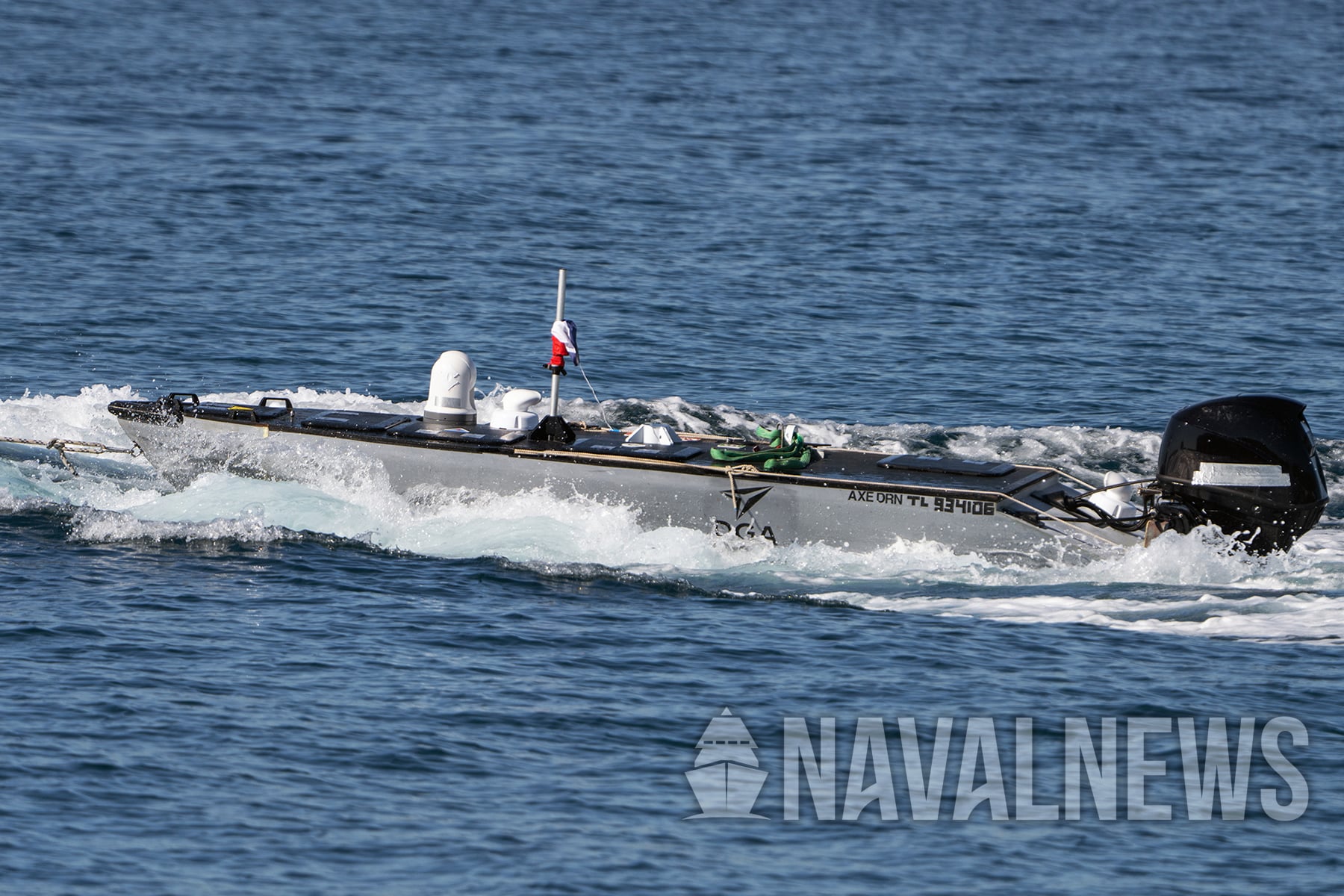
The SMOKERS family of loitering munitions, an acronym for “Scalable Maritime Operational Kamikaze System, Developed under Sovereign Control”, exemplifies this effort. Transitioning from initial concept to a product mature enough for recent French Navy exercises took just six months. This initiative draws directly from operational lessons learned in Ukraine and the Arabian Gulf.
These Unmanned Surface Vessels (USVs) feature resin-fiberglass composite hulls and are powered by standard outboard motors—similar to those on rigid-hulled inflatable boats (RHIBs)—to minimize cost and complexity. Unit costs are targeted at a few tens of thousands of euros. Capable of speeds around 40 knots across various sea states, they carry an explosive payload “sufficient to inflict significant damage on a first-rate enemy vessel,” according to the DGA. The pyrotechnic system is 3D-printed. Demonstrating its internal capabilities, DGA engineers coded the autonomous software and integrated the onboard sensors.
In-House Engineering and Prototyping
The DGA told Naval News that several internal entities collaborated on the development. Project management was led by CERDAN (Centre Expert Référent sur les Drones Navals), one of the DGA’s five expert centers, located at the DGA Naval Techniques (DGA TN) site in Toulon. DGA TN oversaw the initial “SMOKERS V0” prototype. Through its Naval Drone Systems (SDN) department, DGA TN developed the “dronization” suite—the systems needed to convert a standard craft into a drone—and the infrastructure for its operational deployment. This reflects a hands-on “Gyro Gearloose” engineering spirit, where experts directly execute technical work rather than solely managing contractors. Specifically, DGA TN teams designed the electronic and IT architecture, developed the onboard software and remote-control interface, integrated the components, and commissioned the system.
DGA Hydrodynamic Techniques (DGA TH) applied its expertise to the hydrodynamic design and navigation control software. This center typically specializes in scale models used to evaluate the maneuverability and at-sea performance of complex French Navy vessels. Following the initial prototype, DGA TH developed an upgraded “SMOKERS V1.0” platform. The team established an autonomous, small-scale composite production capability complete with master models, female molds, and specialized tooling. Officials noted that the center “designed and manufactured the drone’s platform—encompassing all its vital functions, excluding the payload—leveraging its own design office and manufacturing facilities, which include 3D printers to accelerate the prototyping process.”
Validating SMOKERS Kamikaze USV Performance at Sea
Successive test campaigns on land and under real-world sea conditions in Toulon and Cherbourg validated the USV’s functions. Over four sea-trial campaigns have been completed to date, including tests to assess the USV’s detectability by French Navy surface sensors. The prototypes reached a maturity level allowing the deployment of three USVs during the recent WildFire exercise, which focused on multi-domain counter-drone operations. As Naval News observed while embarked on the Mistral-class LHD Tonnerre, at least one USV was configured specifically as a target. Painted white, it featured a reduced equipment suite, omitting the infrared (IR) sensors, SATCOM antennas, and pyrotechnic payload compartment found on the operational “grey” variant.
French Navy crews operated the USVs from the air-defense destroyer Chevalier Paul, the LHD Tonnerre, and the supply vessel Jacques Stosskopf. Technical support was provided by DGA TN and DGA TH personnel under CERDAN’s coordination. “This phase at sea allows us to continue improving the system’s reliability and to begin discussions regarding its industrialization,” the DGA stated.


A Strategy for Mass Production
Internal resources from the participating DGA centers currently fund the project. If the French Navy proceeds with procurement, it will be financed through its dedicated equipment budget. Because the DGA owns the SMOKERS design blueprints and intelectual property, it can distribute production specifications to local shipyards for rapid, large-scale manufacturing. The DGA emphasized that the design is “uncomplicated and can therefore be produced by the myriad of small shipyards along the French coast, including those that build leisure boats.”
“The SMOKERS prototypes were conceived for easy, low-cost industrialization, with a focus on ‘mass production.’ This opens the door to all types of shipyards: Civilian or military, large corporations or SMEs.”
DGA
With this project, the French Navy and the DGA are advancing their roadmap for Unmanned Surface Vessels (USVs), building on prior trials conducted against actual targets, most notably in April 2025 with remotely operated jet skis converted into targets. This now enables rapid scaling, allowing for “real-time adaptation to the requirements of operational personnel.”